
Why it matters
Konark is a high point of Kalinga architecture and one of India's most ambitious sculptural monuments.
History & context
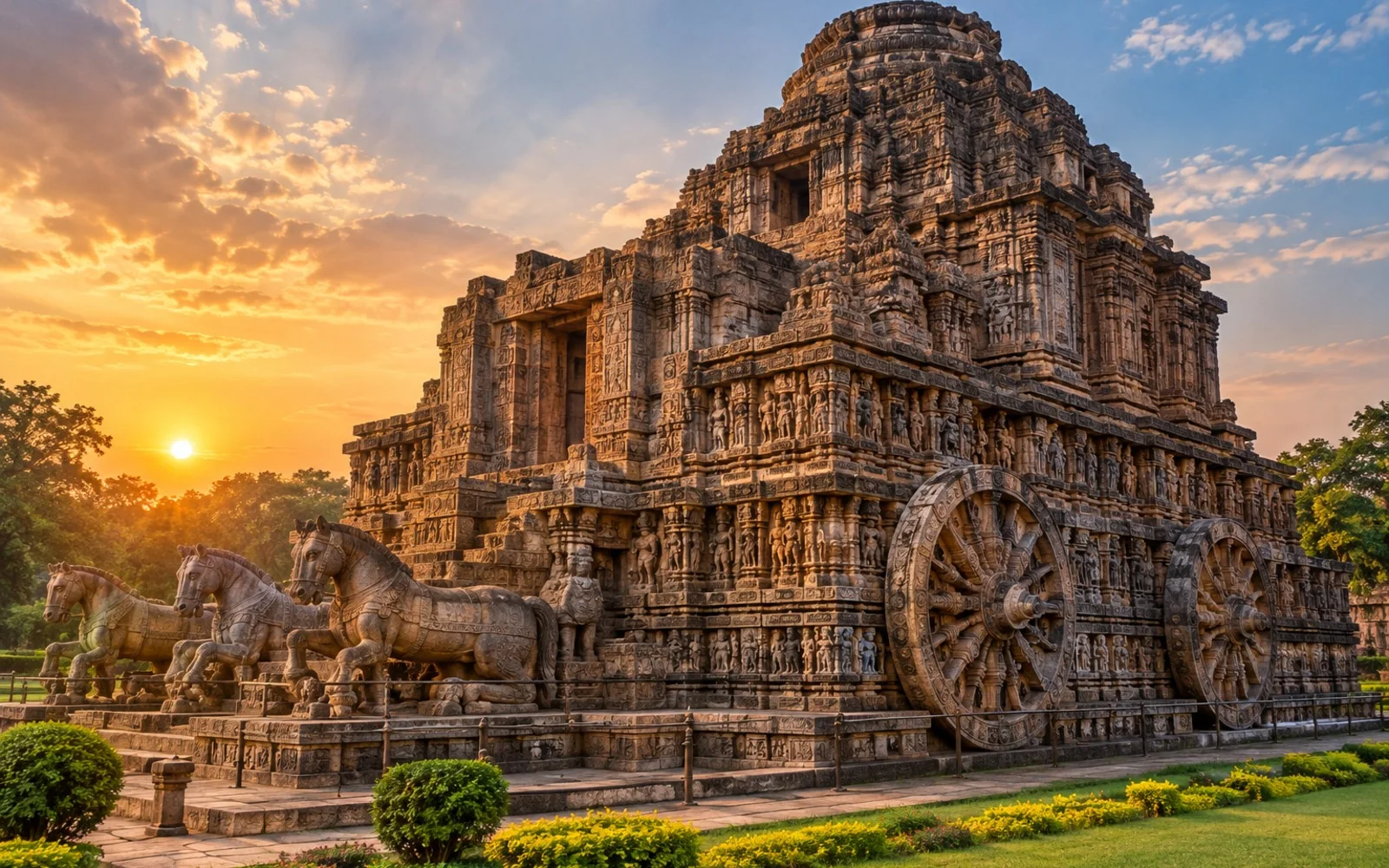
The Sun Temple at Konark, on the Odisha coast, was built around 1250 under King Narasimhadeva I of the Eastern Ganga dynasty. It is designed as a colossal chariot for Surya, the Sun god, with twenty-four carved stone wheels and teams of horses. The main tower collapsed long ago, and in 1903 the surviving assembly hall (jagamohana) was filled with sand and sealed to keep it standing. Sailors once called the temple the "Black Pagoda" and used it as a landmark. Konark became a UNESCO World Heritage Site in 1984.
Architecture & landscape
Each wheel is about three metres across and doubles as a sundial. The walls carry sculptures of musicians, dancers, animals and everyday life.
Timeline
c. 1250
Temple built under Narasimhadeva I
1903 CE
Assembly hall filled with sand to stabilise it
1984 CE
Inscribed as a UNESCO World Heritage Site