
Why it matters
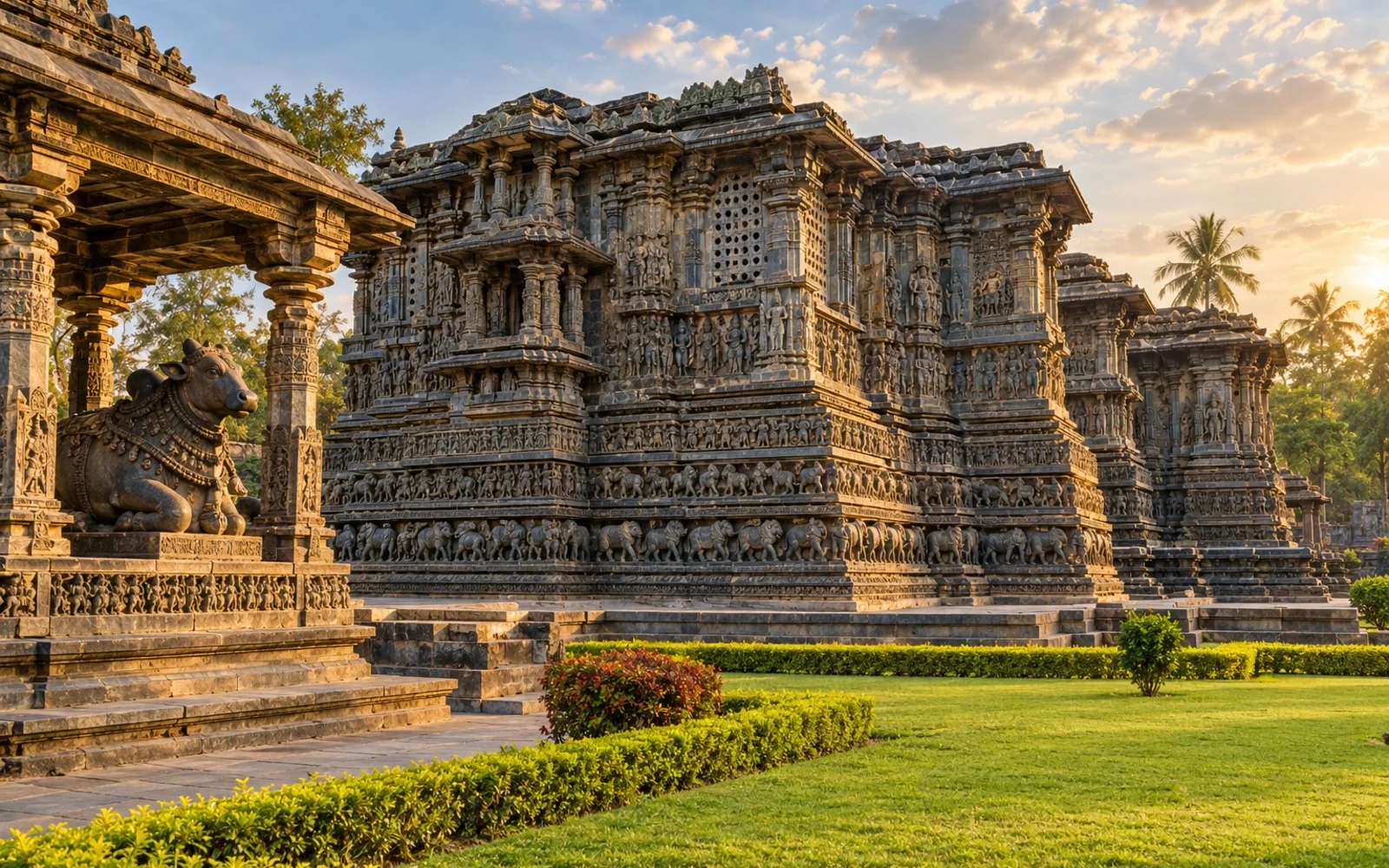
Halebidu's friezes are among the most detailed sculptural programmes in India.
History & context
Halebidu, the medieval Dwarasamudra, was the Hoysala capital from the twelfth to the fourteenth century. The city was sacked by Malik Kafur's army in 1311 and again in the 1320s, and the name Halebidu means "old capital". The Hoysaleswara temple, a twin-shrined temple to Shiva begun around 1121, is covered with friezes showing elephants, horsemen and scenes from the Ramayana, Mahabharata and Puranas. Nearby are the Kedareshwara temple and a group of Jain basadis. Halebidu is part of the UNESCO World Heritage Site "Sacred Ensembles of the Hoysalas", inscribed in 2023.
Architecture & landscape
The Hoysaleswara temple has two identical shrines side by side, each with a Nandi pavilion, set on a high platform carved with horizontal bands of sculpture.
Timeline
c. 1121
Hoysaleswara temple begun
1311 CE
City sacked by Malik Kafur's army
2023 CE
Inscribed as a UNESCO World Heritage Site