
Why it matters
Sanchi lets visitors trace the development of Buddhist art and architecture across more than a millennium at a single site.
History & context
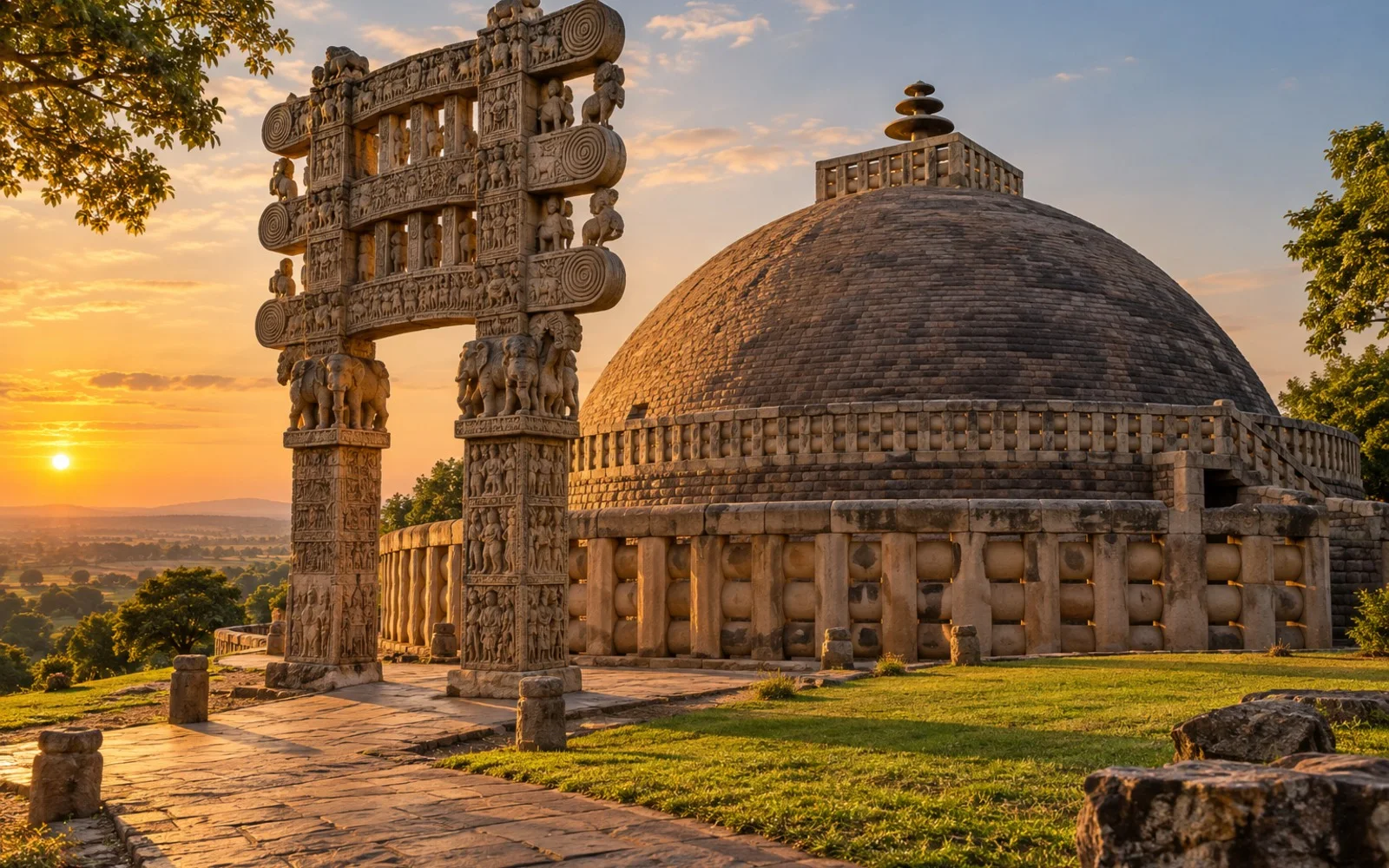
Sanchi, on a hilltop near Vidisha in Madhya Pradesh, has one of the oldest and best-preserved groups of Buddhist monuments in India. The Great Stupa was first built in brick under Ashoka in the third century BCE, enlarged and faced with stone in the second century BCE, and given four elaborately carved gateways (toranas) around the turn of the common era. An inscription on one gateway credits the ivory carvers of Vidisha. Building continued for more than a thousand years, with monasteries, smaller stupas and temples added through the Gupta period and beyond. Temple 17, from the early fifth century, is one of the earliest surviving structural temples in India. Sanchi was rediscovered by British officers in 1818 and restored by John Marshall between 1912 and 1919. It was inscribed as a UNESCO World Heritage Site in 1989.
Architecture & landscape
The gateways tell stories from the Buddha's life and the Jataka tales without ever showing the Buddha in human form; he is represented by symbols such as an empty throne, footprints, a wheel or a tree.
Timeline
3rd century BCE
Ashoka commissions the first stupa
2nd century BCE
Stupa enlarged and faced with stone
1st century BCE–1st century CE
Carved gateways added
1818 CE
Site rediscovered
1989 CE
Inscribed as a UNESCO World Heritage Site