
Why it matters
Somnath's cycle of destruction and renewal has made it a powerful symbol in Indian history and memory, as well as a major pilgrimage site.
History & context
Somnath, at Prabhas Patan on the Saurashtra coast, is the first of the twelve jyotirlinga shrines of Shiva in Hindu tradition. Prabhas is also traditionally linked with the last days of Krishna. The temple has a long history of destruction and rebuilding. It was raided by Mahmud of Ghazni in 1025–26 and later rebuilt; an inscription records rebuilding under the Chaulukya king Kumarapala in 1169. After further destruction, Ahilyabai Holkar built a separate temple nearby in 1783. The present temple, built after independence on the initiative of Sardar Vallabhbhai Patel, was consecrated in 1951 in the presence of President Rajendra Prasad.
Architecture & landscape
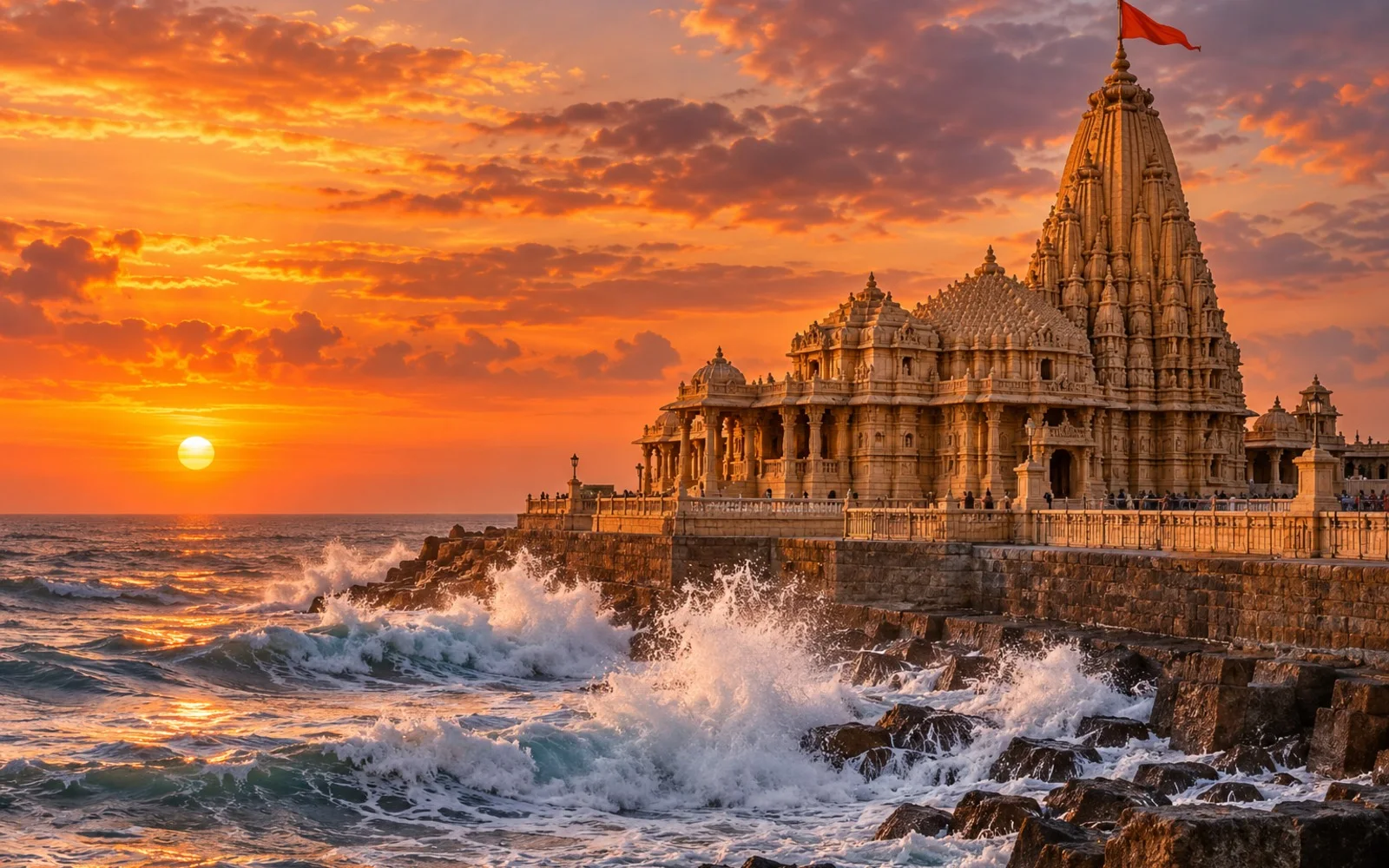
The present temple follows the Chaulukya (Maru-Gurjara) style of western India, with a tall shikhara and finely carved stone.
Timeline
1026 CE
Raided by Mahmud of Ghazni
1169 CE
Rebuilt under the Chaulukya king Kumarapala
1783 CE
Ahilyabai Holkar builds a temple nearby
1951 CE
Present temple consecrated