
Why it matters
Ajanta preserves painting traditions that have almost completely vanished elsewhere, and influenced Buddhist art across Asia.
History & context
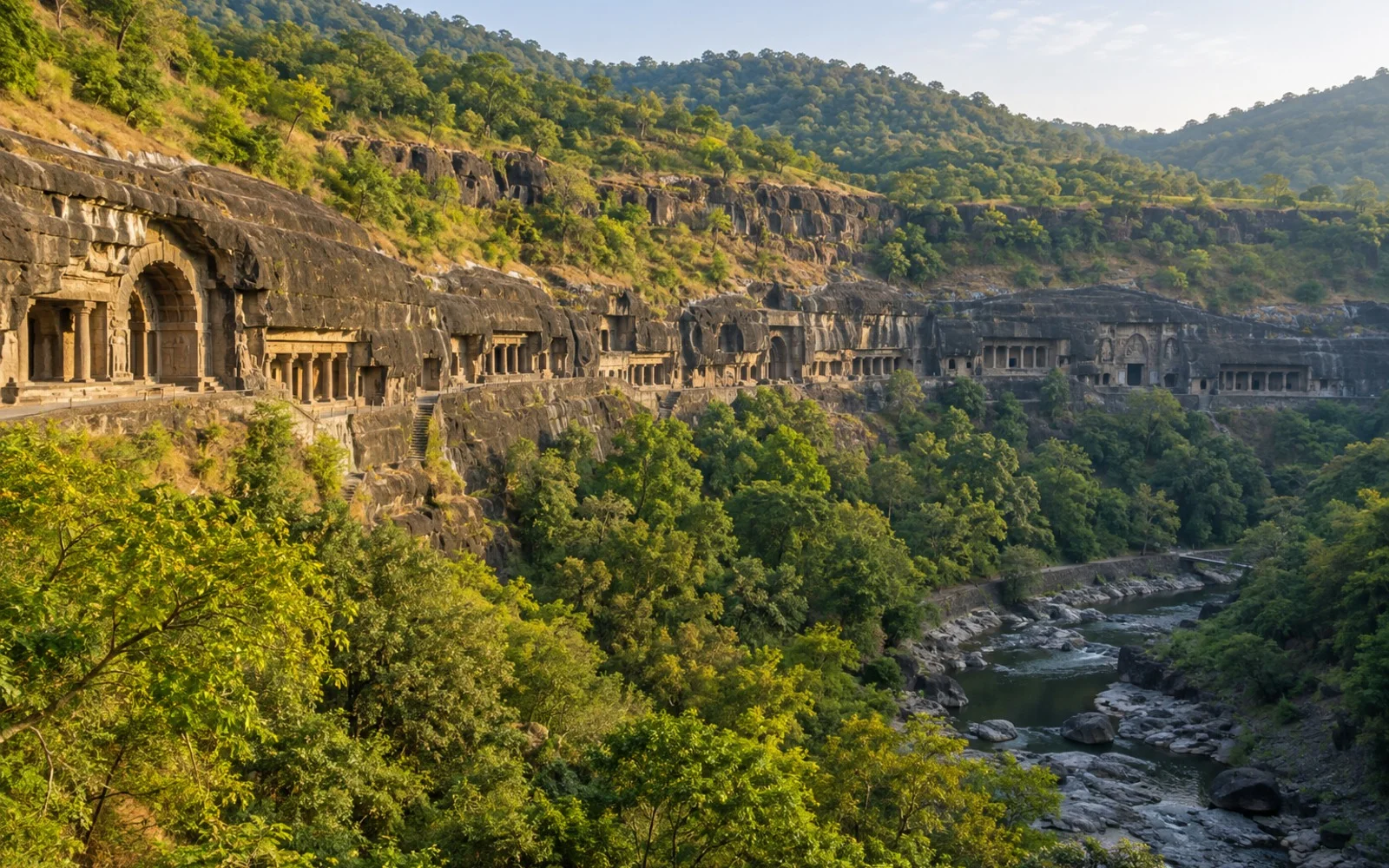
The Ajanta Caves are about thirty rock-cut Buddhist monuments carved into a horseshoe-shaped cliff above the Waghora river in Maharashtra. They were made in two phases: an early group in the second and first centuries BCE, and a later, richer group in the fifth century CE under the Vakataka dynasty, especially during the reign of Harishena. Ajanta is famous above all for its paintings, the finest surviving examples of early Indian mural art. They show scenes from the Buddha's lives and the Jataka tales, crowded with courtly figures, animals and architecture; the Bodhisattva Padmapani in Cave 1 is among the best known. The caves were abandoned and forgotten until a British officer, John Smith, came upon them in 1819. They became a UNESCO World Heritage Site in 1983.
Architecture & landscape
The caves include chaityas (prayer halls with a stupa) and viharas (monasteries), carved entirely out of the living basalt rock to imitate timber construction.
Timeline
2nd–1st century BCE
First phase of caves carved
c. 460–480 CE
Second phase under the Vakatakas
1819 CE
Caves rediscovered by John Smith
1983 CE
Inscribed as a UNESCO World Heritage Site