
Why it matters
Ellora is a remarkable record of religious coexistence and of what rock-cut architecture could achieve.
History & context
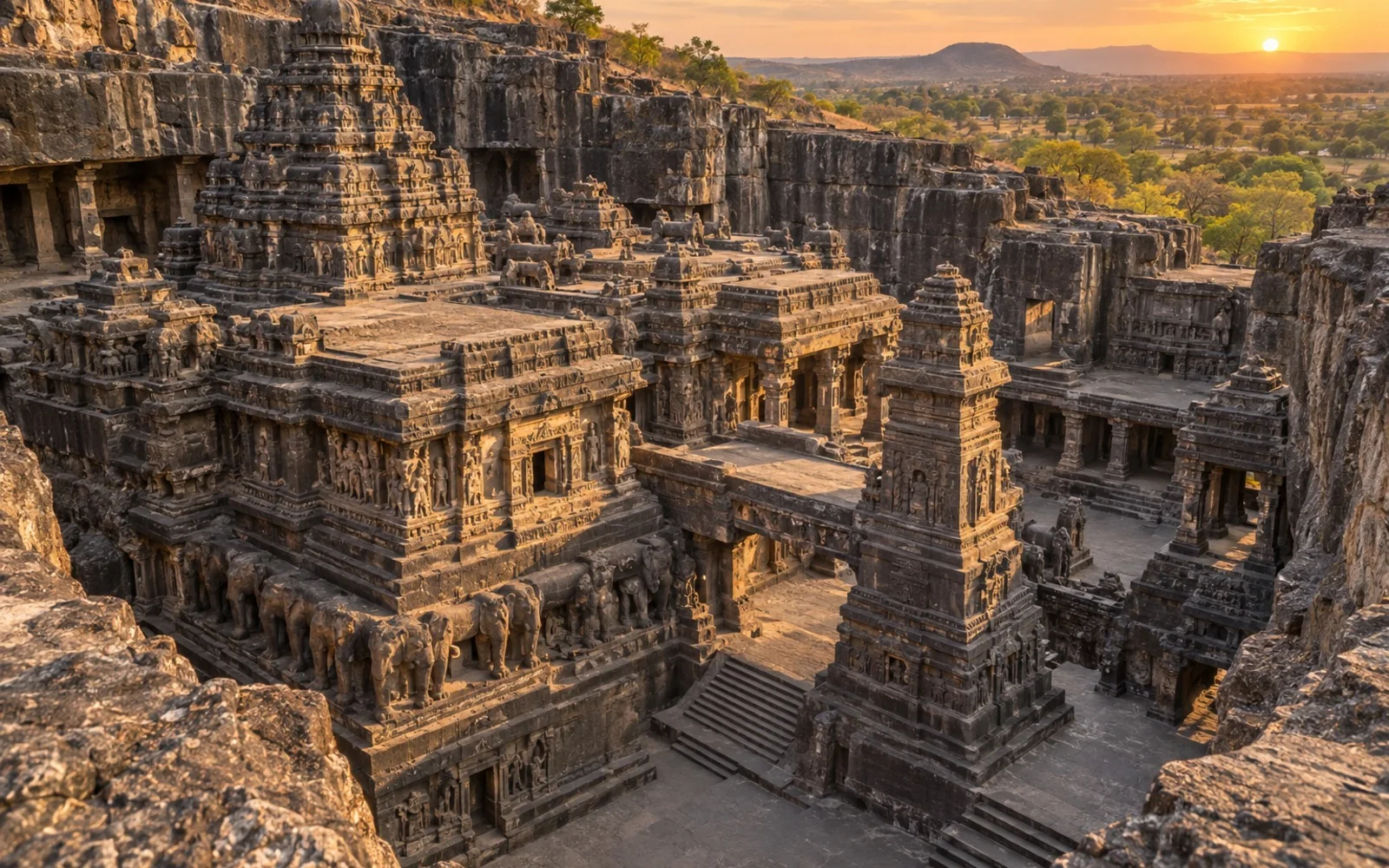
Ellora, near Chhatrapati Sambhajinagar (Aurangabad) in Maharashtra, has thirty-four rock-cut caves made between about the sixth and tenth centuries. Buddhist, Hindu and Jain monuments stand side by side, showing how these traditions shared the same landscape. The most celebrated is Cave 16, the Kailasa temple, cut from the top down out of a single mass of rock under the Rashtrakuta king Krishna I in the eighth century. It is one of the largest monolithic structures in the world. The Buddhist caves include the three-storeyed Tin Tal, and the Jain caves have finely carved halls. Ellora became a UNESCO World Heritage Site in 1983.
Architecture & landscape
The Kailasa temple is a complete free-standing temple, with courtyard, shrine, bridges and life-size elephants, carved downward and inward from the hillside rather than built.
Timeline
c. 6th–7th century
Buddhist caves carved
8th century
Kailasa temple carved under Krishna I
9th–10th century
Jain caves carved
1983 CE
Inscribed as a UNESCO World Heritage Site