
Why it matters
Sarnath links a founding moment of Buddhist tradition with hard archaeological evidence, and its lion capital became a symbol of the modern Indian state.
History & context
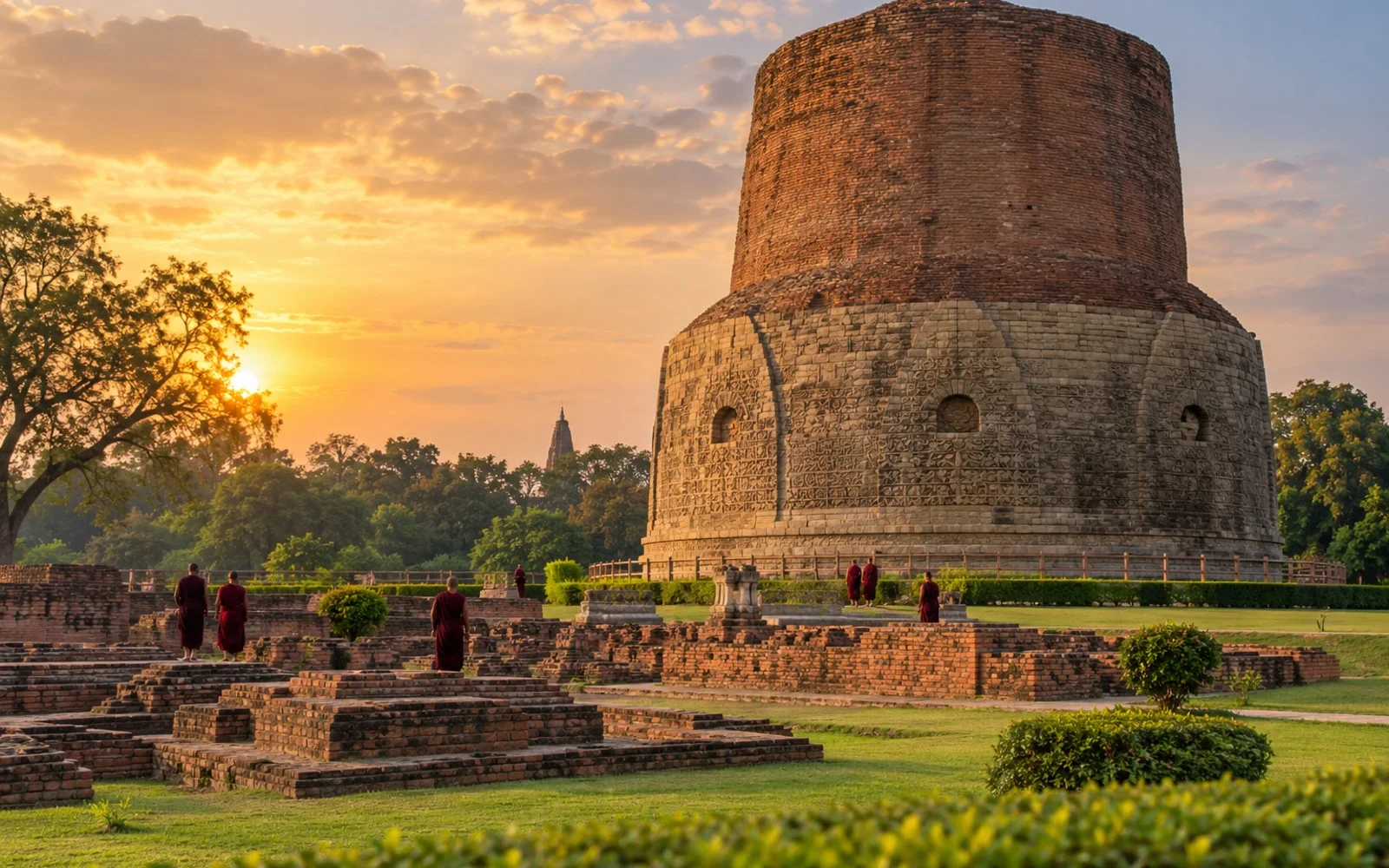
Sarnath, about ten kilometres north-east of Varanasi, is where Buddhist tradition places the Buddha's first sermon after his enlightenment — the "turning of the wheel of Dharma" — delivered in a deer park to five former companions. The site grew into a major monastic centre. The Mauryan emperor Ashoka erected a polished sandstone pillar here in the third century BCE; its lion capital, now in the Sarnath Museum, was adopted as the State Emblem of India in 1950. The great Dhamek Stupa in its present form is largely of the Gupta period. The Chinese pilgrim Xuanzang described a flourishing monastery in the seventh century. Sarnath declined after about the twelfth century and was excavated from the nineteenth century onward; the lion capital was uncovered in 1905.
Architecture & landscape
Remains include the cylindrical Dhamek Stupa, the base of the Dharmarajika Stupa, monastery foundations, the stump of the Ashokan pillar, and the Mulagandhakuti Vihara, a modern temple built in 1931.
Timeline
c. 5th century BCE
Buddha's first sermon, according to Buddhist tradition
3rd century BCE
Ashoka erects the lion-capital pillar
c. 5th–6th century CE
Dhamek Stupa takes its present form
1905 CE
Lion capital excavated
1950 CE
Lion capital adopted as the State Emblem of India