
Why it matters
Vrindavan shows how a sacred geography described in texts was mapped onto a real landscape by devotional movements, and how that landscape still shapes religious life.
History & context
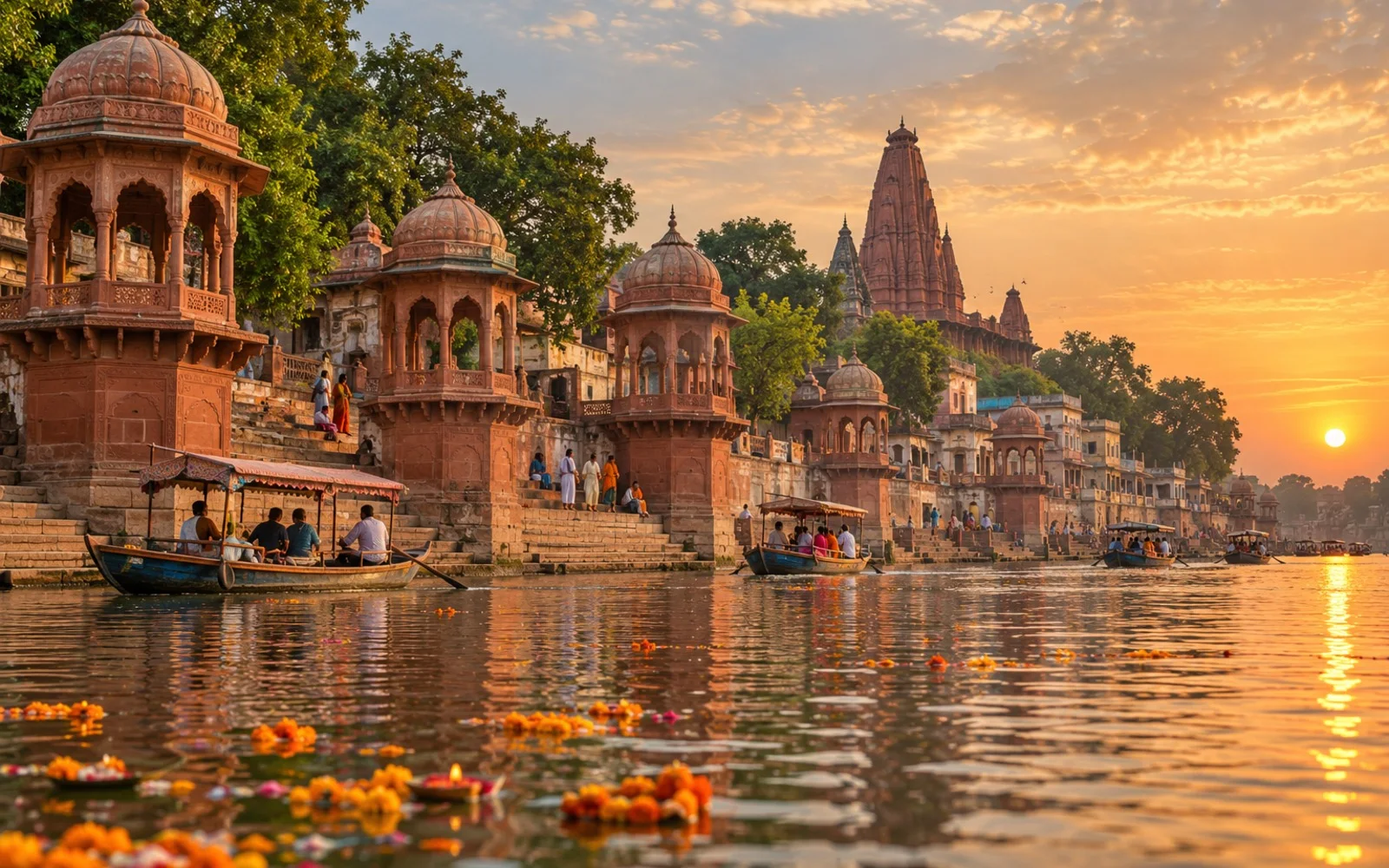
Vrindavan lies on the Yamuna a few kilometres north of Mathura. In Krishna devotional tradition it is the forest where Krishna spent his youth among the cowherds and the gopis, and the setting of the Rasa Lila described in the Bhagavata Purana and Gita Govinda. The town as a major pilgrimage centre took shape in the sixteenth century. Chaitanya Mahaprabhu visited around 1515, and his followers, the Goswamis of Vrindavan, identified sacred sites and wrote influential theological works. Large temples followed, notably the red sandstone Govind Dev temple, built in 1590 under Raja Man Singh of Amber. The Banke Bihari temple dates from 1864. Today Vrindavan has thousands of temples and ashrams and remains a centre of Krishna bhakti.
Architecture & landscape
The Govind Dev temple combines north Indian temple forms with vaulted interiors influenced by contemporary Mughal building, a striking experiment of the late sixteenth century.
Timeline
c. 1515
Chaitanya Mahaprabhu visits Vrindavan
1590 CE
Govind Dev temple built under Raja Man Singh
1864 CE
Banke Bihari temple built