
Why it matters
Few cities anywhere show such a long continuity of religious, scholarly and artistic life in one place. Varanasi is central to Hindu ideas of pilgrimage and liberation, and sits a short distance from one of Buddhism's founding sites.
History & context
Varanasi, also known as Kashi and Banaras, stretches along a crescent-shaped bend of the Ganga in eastern Uttar Pradesh. Excavations at Rajghat, on the city's northern edge, show settlement from around the early first millennium BCE, and early Buddhist and Jain texts list Kashi among the sixteen great states (mahajanapadas) of northern India. The Buddha delivered his first sermon at nearby Sarnath. Over the centuries the city became one of the most important pilgrimage centres in Hinduism, closely associated with Shiva and with rites for the dead performed on its riverbanks. Many of the ghats and temples seen today were built or rebuilt in the eighteenth and nineteenth centuries by Maratha, Rajput and other patrons; the present Kashi Vishwanath temple was built under Ahilyabai Holkar in 1780. Varanasi is also linked with the poet-saint Kabir, with Tulsidas, and with long traditions of Sanskrit learning, music and silk weaving. Banaras Hindu University was founded here in 1916.
Architecture & landscape
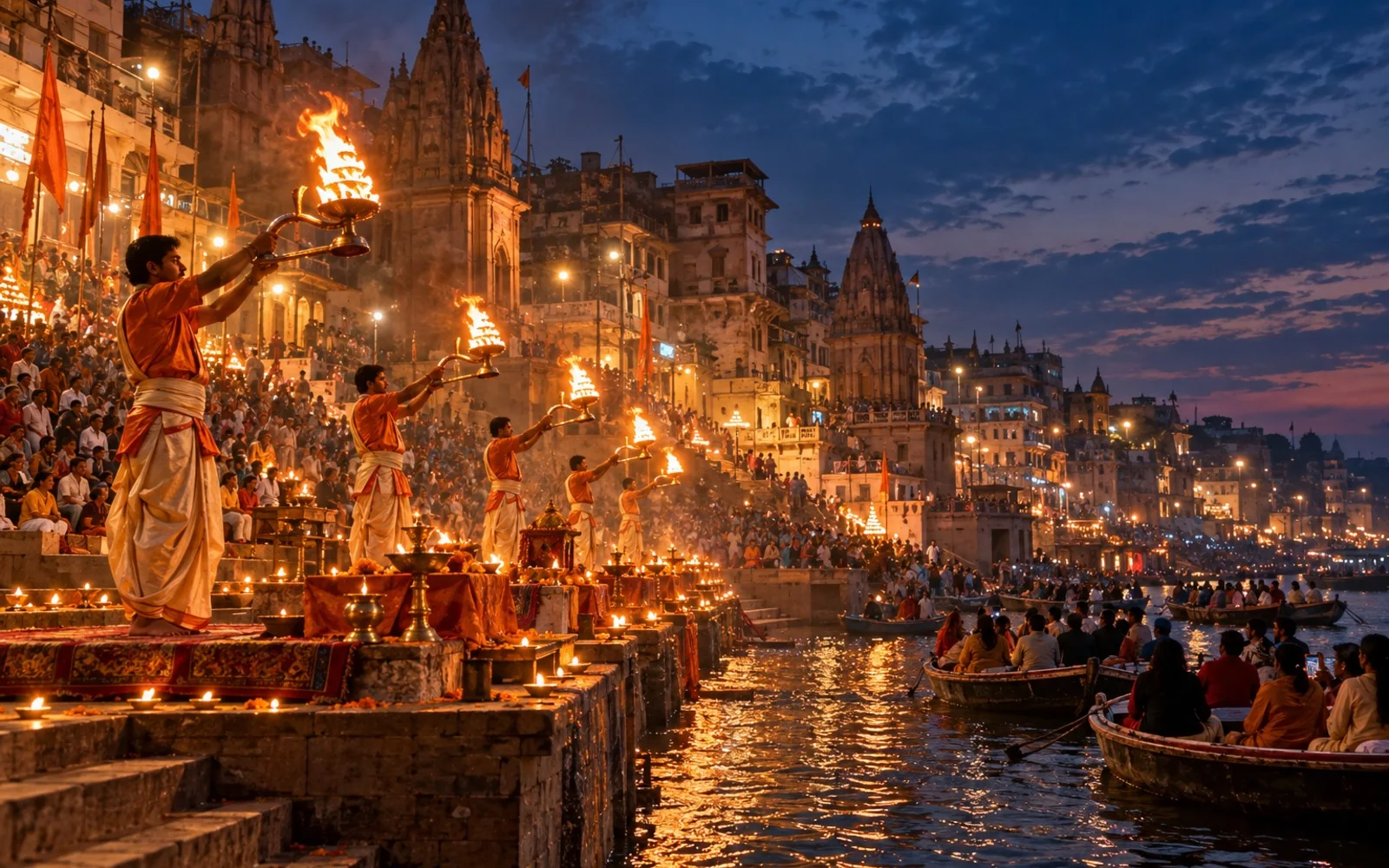
The riverfront is a continuous sequence of more than eighty ghats — stone steps leading to the water — lined with temples, palaces and monasteries. Most of the visible riverfront dates from the eighteenth century onward.
Timeline
c. 800 BCE
Early settlement at Rajghat
c. 6th century BCE
Kashi named among the sixteen mahajanapadas
1780 CE
Kashi Vishwanath temple rebuilt under Ahilyabai Holkar
1916 CE
Banaras Hindu University founded